
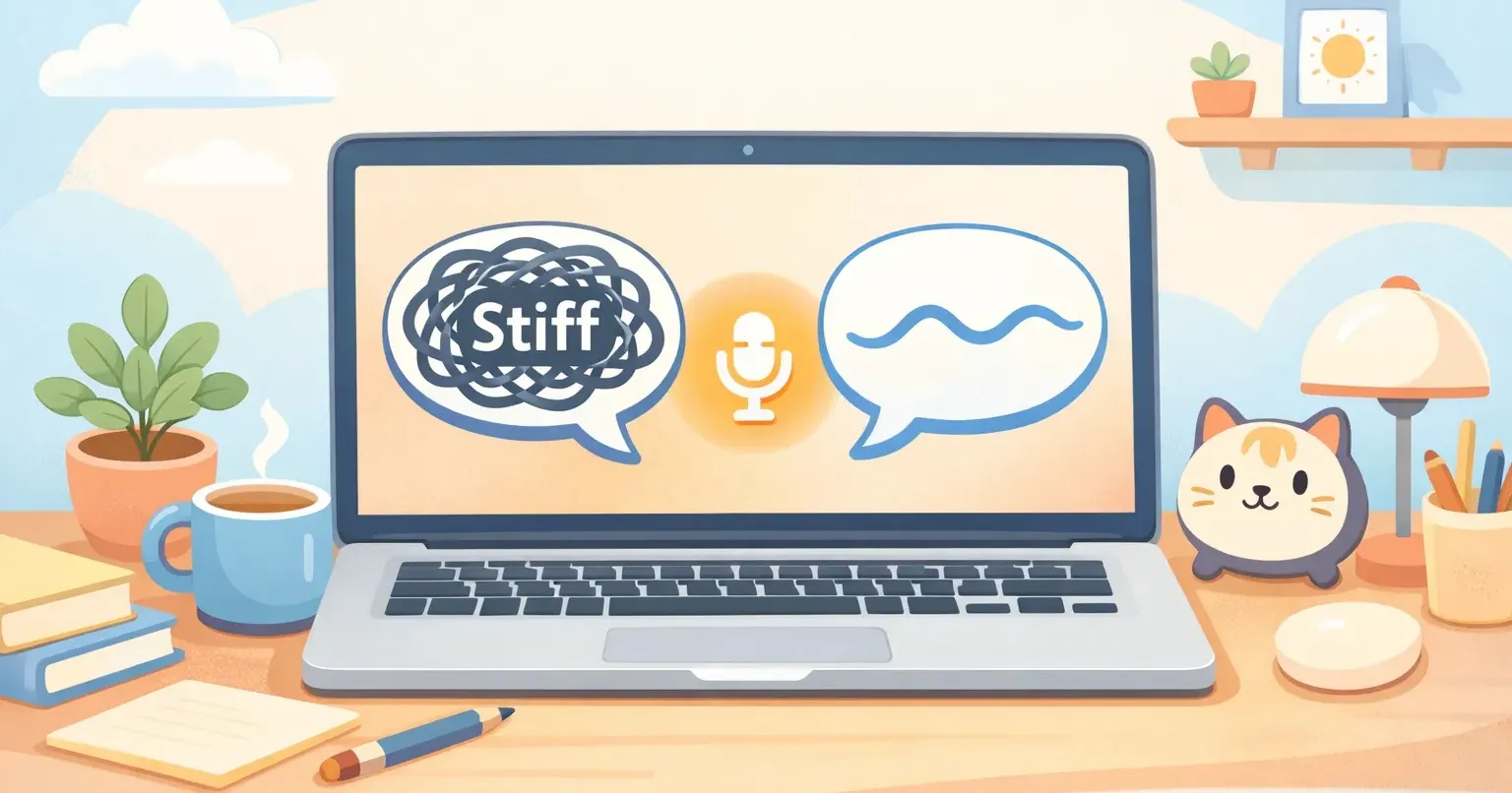
You've rewritten the same Slack message four times. You delete *Hello team, I would like to ask if it is possible to schedule a brief meeting*. You try *Hi team, can we set up a quick chat?* Then you start wondering if *set up* sounds too casual, switch back to *schedule*, then delete the whole thing. Fifteen minutes are gone.
Yesterday in the meeting you spoke fine. Nobody flinched at your English. So why does typing feel so much harder?
You're not alone in this. Roughly 1.12 billion non-native English speakers use the language for work, against about 380 million native speakers, and only 4% of global conversations happen between two native speakers. Most of the people reading your messages aren't sitting there hunting for mistakes. They just want the point. Still, sounding stiff or *translated* costs you. It changes how seriously your writing gets taken, and it eats hours every week.
Why Your Written English Sounds Less Native Than Your Spoken English
When you speak, you don't have time to translate. Your mouth runs on autopilot, pulling from chunks of English you've actually heard people use. You say *let me get back to you on that*, not *I will revert with my response shortly*, because the first one is what your ear knows.
Writing flips that. You stop. You hover over the keyboard. The more time you have, the more your brain slips into translation mode. You compose in your first language, then convert it word by word. That's where the stiffness creeps in. Your first language has a rhythm and a politeness structure of its own. When you layer it onto English, you sound formal where native writers would be casual, and sometimes too casual where they'd be sharper.
Linguists call this L1 transfer, and one corpus study found it accounts for roughly 88% of writing errors made by non-native speakers. Most of those aren't grammar errors. They're rhythm and word-choice mismatches. The grammar checks out. It just doesn't *feel* English.
What "Native" Writing Actually Looks Like
A lot of non-native writers assume sounding native means rich vocabulary or perfect grammar. It doesn't. Native business writing is usually shorter and more direct than what non-native speakers produce. The signals that actually mark someone as a native writer are smaller and weirder than you'd guess.
Here are the markers that matter: - Mixed sentence length. A native writer follows a 20-word sentence with a 4-word one. Non-natives tend to keep every sentence the same medium length. - Contractions everywhere casual. *I'll send it.* *We're meeting at 3.* *That doesn't work for me.* Skipping contractions in a peer-level Slack message is the clearest signal that English isn't your first language. - Phrasal verbs over single-word verbs. Native speakers *set up* a meeting (not *schedule*), *get back to* you (not *respond*), *figure out* a bug (not *resolve*). The single-word version isn't wrong. It just reads as a translation. - Direct openings. *Quick question:* or *Heads up:* beats *I hope this message finds you well. I am writing to inquire...* - Hedging without groveling. *Mind taking a look when you get a chance?* works. *Could you possibly please consider reviewing this at your earliest convenience* is too much.
The Phrasal Verb Trick
Phrasal verbs deserve their own section. If you only do one thing from this whole article, do this one.
English carries two parallel vocabularies. One is Germanic: short, blunt, often two words. The other is Latin: longer, formal, usually one word. When the Normans took England in 1066, the ruling class spoke French, so English ended up with Germanic words for everyday life and French- or Latin-rooted words for fancier settings. That split is still here, almost a thousand years later.
In modern offices, the everyday register dominates Slack, email, and most internal docs. But non-native speakers, who learned English in formal classes, default to the Latinate version. It's technically correct. It just signals *I learned this in a textbook* instead of *I picked this up at work*.
A quick conversion list: - *establish* → set up - *initiate* → kick off - *postpone* → put off - *investigate* → look into - *resolve* → sort out / figure out - *terminate* → end / wrap up - *increase* → go up / bump up - *contact* → reach out to - *respond* → get back to - *encounter* → run into - *eliminate* → cut / get rid of - *complete* → finish / wrap up
Don't try to memorize all of them. Pick five you tend to overuse and swap them for a week. Your writing will sound noticeably less translated with no other changes.
Match the Register to the Channel
The biggest tell of a non-native writer isn't usually grammar. It's that they write Slack messages with email formality, and emails with proposal formality. A peer-to-peer DM ends up reading like a memo. Native colleagues code-switch automatically. You can train this.
Here's the same message in three registers.
Slack DM to a teammate (casual)
hey, got a min to look at the auth bug? something weird w/ the logout flow
Email to a cross-team colleague (neutral)
Quick one. Could you take a look at the logout flow when you have a moment? We're seeing something odd in the auth logs.
Email to a VP (formal but not stiff)
Could I borrow ten minutes this week to walk you through an issue we've spotted in the logout flow? Happy to send a written summary if that's easier.
None of these are wrong. They're calibrated for context. The Slack version drops capitals and uses contractions and abbreviations. The peer email keeps contractions but adds a soft *when you have a moment*. The exec email adds structure (*walk you through*, *happy to send*) without going Victorian on it.
The fastest way to learn this calibration is to collect templates from native colleagues. Save messages you've received that struck the right tone. Reuse the structure. That's how native writers learned the patterns themselves, by exposure.
The Over-Formality Trap
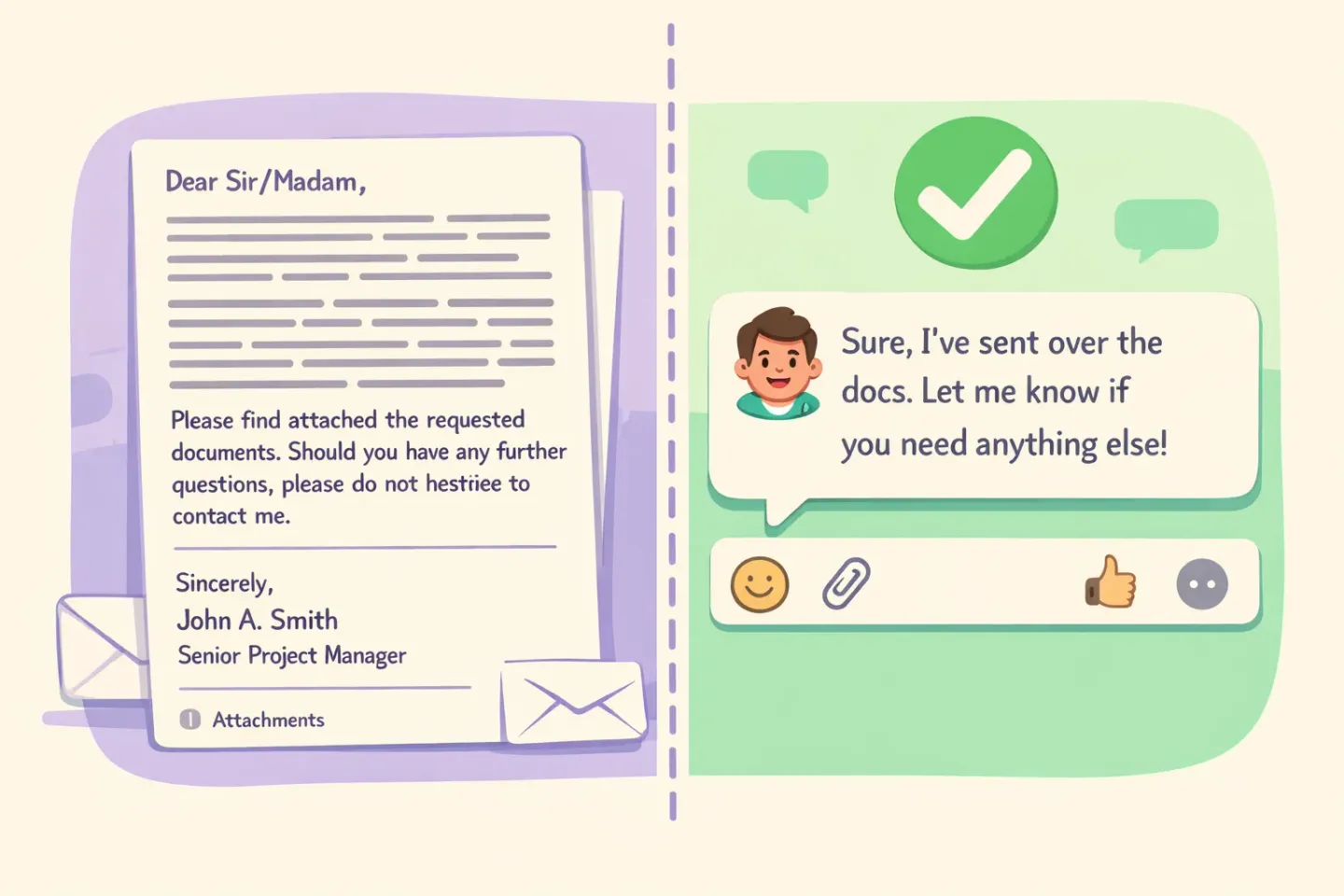
If you grew up in a culture where written communication is formal by default (German, Japanese, French, much of Latin America, parts of South Asia), you'll probably overshoot in English. A few common ones that read as foreign: - *I would like to kindly inquire...* → Quick question: - *Please find attached...* → Attached is... or just *Here's the doc.* - *I am writing to inform you that...* → Heads up, or *Just letting you know...* - *Please do not hesitate to contact me.* → Let me know if anything's unclear. - *Awaiting your kind response.* → Let me know when you can. (Or skip the line entirely.) - *Dear Sir/Madam* → Use a first name, or *Hi team.*
Over-formality reads as foreign because modern English-speaking workplaces, particularly in the US but increasingly everywhere, run on flat hierarchy. Heavy politeness implies distance, which can come across as cold or even faintly sarcastic. If you're writing to a senior person, the move is to be more concise, not more formal. Native writers signal respect by not wasting the reader's time.
Speak It First, Then Refine
Here's the move that bypasses the translation reflex entirely: stop trying to *write* native English. Speak it.
When you talk through your message out loud, even just to your phone or a transcription tool, you pull from the spoken English patterns you've already internalized. Sentences come out shorter. You use contractions without thinking, and you reach for phrasal verbs because that's what your ear knows. The grammar largely self-corrects, too: you've heard a lot more spoken English than you've ever consciously studied written.
Then you clean it up.
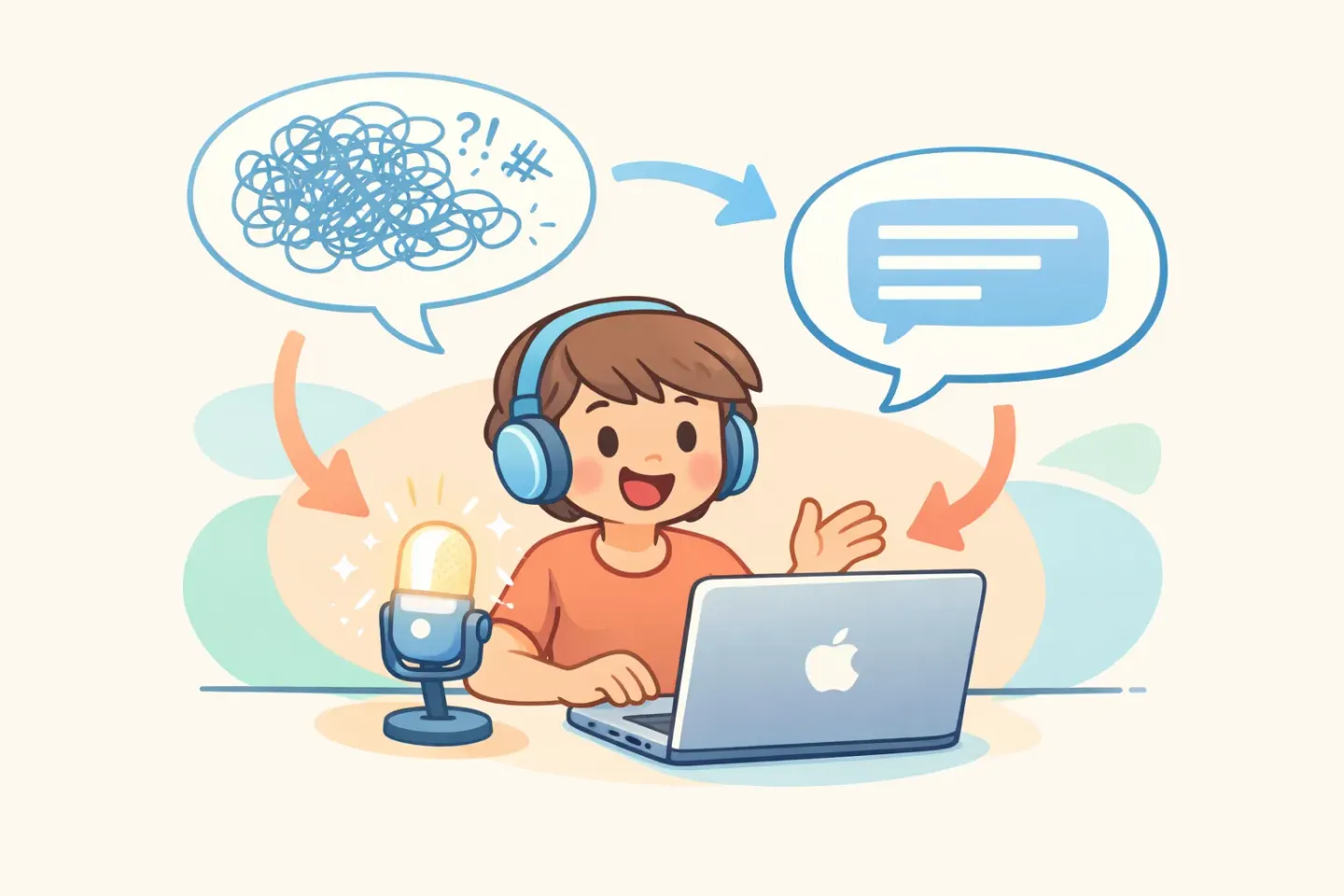
The two-step looks like this: 1. Speak the message into a voice note or transcription tool. Don't edit while you speak. Just say what you mean, the way you'd say it in a meeting. 2. Polish the transcript. Trim filler words. Fix the obvious slips and adjust the register for the channel. This works because the bottleneck for non-native writers isn't really English knowledge. It's the act of composing in English at the keyboard. You already know what natural English sounds like. You just lose access to it when you're typing. Speaking puts it back in reach.
If you want to skip the manual polish step, that's the loop Voicr handles on a Mac. Hold FN, talk, release. The polished text lands in your clipboard with filler words gone and the register matched to whichever app you're in. You're not learning to write more native English. Your spoken English is already doing the work for you.
Quick Wins You Can Use in Your Next Message
If you only take three things from this: 1. Use contractions in every casual or peer-level message. *I'll* not *I will*. *We're* not *We are*. *Don't* not *Do not*. *That's* not *That is*. This one change pulls a surprising amount of foreign feel out of your writing. 2. Swap five Latinate verbs for phrasal verbs. Start with *set up*, *get back to*, *look into*, *figure out*, *reach out to*. Use them this week. Catch yourself when you reach for *schedule*, *respond*, *investigate*, *resolve*, *contact*. 3. Speak your next email out loud before you type it, even just whispering at your desk. Notice how the spoken version is shorter and more direct, then write that version.
The deeper shift is this. Your English vocabulary and grammar are usually fine. What gets in the way is the over-formality and translation rhythm sitting on top of it. You don't need to add more native expressions. You need to take out what doesn't belong. The clear thinker who shows up in your meetings is the same person who should be showing up in your writing.
If you want a permanent shortcut on a Mac, Voicr runs the whole speak-then-polish loop in a single keypress. Speak naturally and it gives you back clean, register-matched text ready to paste. No translation step in the middle. No second-guessing the wording. You press, you talk, you paste, and your written English starts to read the way you actually think.