

In Spanish, you're the one who makes the team laugh. In French, you write the email everyone forwards because it lands so perfectly. In German, you can be warm and precise at the same time without sounding stiff. Then you open Slack in English, and a stranger shows up to type for you.
The stranger is polite. The stranger is correct. The stranger is also nothing like you.
If you work in English but it's not your first language, this is the quiet tax you pay every day. Your humor flattens. Your warmth gets formal. Your sharp edges round off into "Just wanted to circle back." You stop sounding like the person your colleagues would actually want to grab coffee with.
It isn't a small problem either. In one workplace survey, 40% of non-native English speakers said they avoid speaking up in meetings because they're afraid of being misunderstood. Most of those people aren't bad at English. They're losing themselves in it.
The good news: this is fixable. You don't need two years of accent coaching. You need a different workflow.
The voice tax: why you sound different in English than at home
Three things happen the moment you switch into English at work.
First, you reach for safe words. Anything with risk attached, like a joke, a metaphor, an emotional aside, gets cut because you can't fully predict how it'll land. Safe English is also bland English.
Second, you over-correct for formality. School taught you English is a polite language, so you pile on "kindly," "please be advised," and "I hope this email finds you well." Native speakers almost never write like that anymore. You end up stiffer than the people you're writing to.
Third, you translate. Even when you don't realize it, part of your brain is running everything through your native language first, then converting. That extra step strips the personality out before the words ever hit the screen.

What Spanish, French, and German each do to your English
The patterns aren't random. Each language pushes your English in a different direction.
Spanish speakers
You over-soften. Spanish gives you beautiful indirect constructions, like *quería preguntarte si...* or *me gustaría saber si...*, that translate into long, hedged English. You write "I would like to know if it would be possible for you to..." when a colleague would just say "Can you...?" You also tend to write long sentences with lots of commas, because Spanish loves a comma and English doesn't. The result reads as nervous, not warm.
French speakers
You over-complicate. French rewards intellectual nuance and elegant construction. In English, that turns into sentences with three subordinate clauses and a vocabulary that sounds like a TED talk. You also fall into false friends. "Actually" doesn't mean *actuellement*. "Demand" is much stronger than *demander*. "Eventually" is the opposite of *éventuellement*. Your English ends up sounding either too formal or accidentally rude, depending on the word.
German speakers
You over-direct. German is precise and economical, so your English drops articles, cuts hedges, and lands harder than you meant it to. "Send me the file by Friday" reads warmly in German. In English, it lands like an order. You also tend to put the verb in unusual places, which makes sentences sound textbook-correct but stilted.
None of these patterns are mistakes. They're your native language doing what it's good at, and getting in the way of English doing what it's good at.
The translate-then-fix loop that eats your day
Here's the workflow most people fall into.
You think of what you want to say. Part of that thought is in your native language. You start typing in English. You stop. You re-read. Something sounds off. You delete. You try a different word. You check if it's even a real word. You re-read again. You change the sentence structure. You finally send.
A two-line Slack message just took four minutes.
Now multiply that by every email, every PR comment, every doc, every meeting recap, every status update. Working in your non-native language can add 30 to 90 minutes a day to writing tasks. That's a quarter of your workday gone to language friction.
The worst part: after all that effort, the message that lands often still doesn't sound like you. You paid the time tax and the voice tax. (If this sounds familiar, our earlier piece on how voice dictation can be faster than the keyboard goes deeper into the time math.)
Three habits that protect your voice in English
You can shrink the translate-fix loop without hiring a coach. Three habits do most of the work.
Use contractions on purpose. "I'm," "you're," "we'll," "don't." These are how friendly English actually sounds. School probably taught you to avoid them. School was wrong for the workplace. Every time you write "I am writing to" instead of "I'm writing to," you add a layer of starch.
Cut formal connectors. "Furthermore," "moreover," "in order to," "with regards to." These are leftovers from textbook English. Replace them with "also," "and," "to," "about." Try saying "Moreover, the deadline is approaching" out loud. Now try "Also, the deadline is close." The second one is what your colleague would say.
Trust your first instinct. When you draft something and immediately want to soften it or formalize it, pause. Was the first version actually rude, or just direct? Was it actually unclear, or just short? Most of the time, your first instinct in English is closer to how native speakers write than the polished version you're about to replace it with.
The two-language workflow: think native, write English
Here's the workflow that quietly fixes most of this. It's what the people who write fluent, voiced English at work are already using, even if they can't name it.
Stop trying to think in English. You don't have to.
Think in whatever language your brain naturally uses. Say the message out loud in your native language if it helps. Now write the English version, but don't translate. Write the intent, not the words. What were you really trying to say? Strip away the politeness layer of your native language. Strip away the safe English you'd normally reach for. What's actually the message?
This is faster than translating. It also preserves the personality that translation strips out.
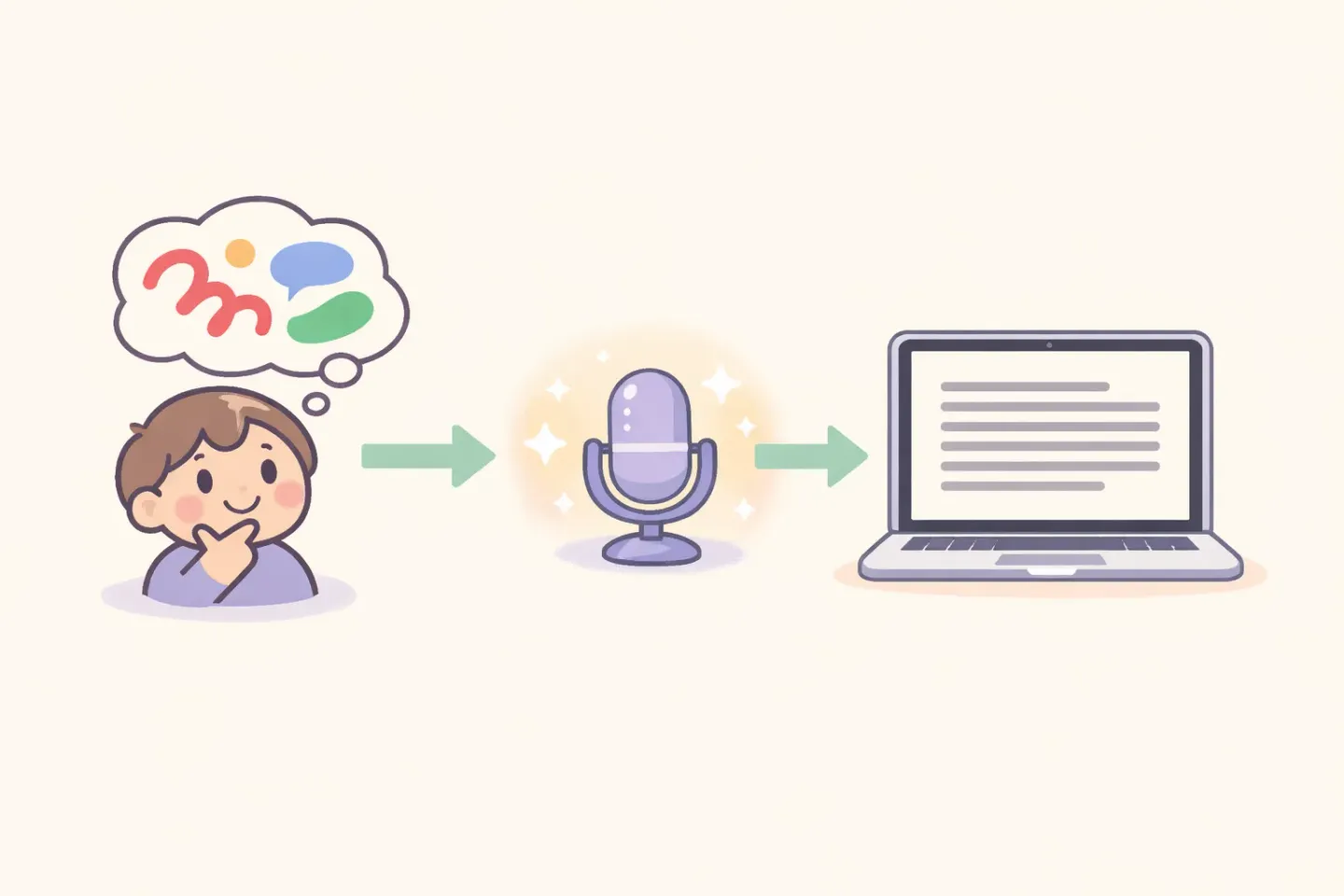
The workflow gets even faster when you stop typing the English part by hand. Dictating in your native language and letting a tool transcribe and polish into English removes the manual translation work altogether. Voicr does this. You hold one key, speak naturally in Spanish, French, or German, and the polished English text lands in your clipboard ready to paste. The polishing step is the difference between sounding flattened and sounding like you. (Voicr supports the full 100-language Whisper catalog with auto-detect, so the language picker stays out of the way too.)
Quick wins for Slack, email, and docs
Different surfaces want different things.
Slack messages: start with a contraction. Lead with the actual question. If you'd answer "yes/no" in your native language, structure it the same way in English. Skip "Hi, I hope you're doing well." Slack isn't email.
Emails to people you know: one-line greeting maximum. Get to the point in the first paragraph. End with "Thanks" or "Cheers" instead of "Best regards" unless you're writing to a stranger or your CEO.
Emails to people you don't know: a slightly more formal opener is fine, but keep the body conversational. The opener and signoff carry the politeness. The middle should sound like you talking.
Docs and PRs: read your final draft out loud in English. If you stumble, the sentence is too long or has too many clauses. Break it. Native speakers almost never write sentences they wouldn't say out loud.
Meeting recaps: write them in your native language first, then convert. The recap is where you most need to sound like yourself, because it's where your judgment shows.
You don't have to pick between you and English
The lie that working in English forces on you is that you have to choose. Sound like yourself, or sound professional. Write fast, or write well. Pick one.
It's a fake choice. The trick is to stop treating English as the first step, the language your thoughts have to be born in, and start treating it as the output step. Your thinking happens wherever it naturally happens. The English version is just the version that gets sent.
The fastest way to feel this for yourself is to try it on the next message you'd normally rewrite three times. Think it in your native language. Speak it out loud, casually, the way you would to a friend who happens to be your coworker. Then write the English version with the goal of capturing that tone, not the textbook one.
If you want this workflow to take seconds instead of minutes, Voicr handles the speaking-and-polishing part with one keystroke. Hold FN, talk in Spanish, French, German, or any of 100 languages, and the polished English text appears wherever your cursor is. The tone you'd actually use stays in the result.
You came to English to do your job. You don't have to leave yourself at the door to do it.